November 15, 2025
White on white – part 2
Part 2
The most peculiar characteristic of the Fresh&Bold Architecture Award – that it can be taken away – is surpassed in peculiarity only by the origin story: a comedic sketch of Top lista nadrealista (the Yugoslavian equivalent of Monty Python) where a 1980s tv correspondent joyfully announces a family he came to confiscate their television.
The organizers communicated me this exceptional footnote to the award among laughter. I don’t know if they are joking nor if they advertised the eventuality to the participants, but I love the idea – so I take them very seriously.
The days of the festival carry an energy that I have never experienced in architecture events; the award categories, intentionally more open than “office spaces, detatched homes, etc.” boosted the discussions to crown winners; I can see that the Jury cares, profoundly. But I know my job doesn’t stop here: I am absolutely determined to assert my veto as Jury President, mercilessly.
So the morning after the final ceremony, with 3 hours to spare before the flight, incognito, I call a cab. I am going to visit the closest building that we awarded, a small mosque designed by the local firm AHAKNAP, at the end of the plain of Sarajevo. After 15 km of traffic the taxi exits the highway and drives through Osjek. The urbanization that we find denotes a general allergy to finishes – be it plaster on homes or asphalt on roads. Everything is still very much under construction, but for years.
The presentation of AHAKNAP made the mosque look like it was located in a recently parceled area, but the array of exposed concrete frames thins out as we get closer to destination, revealing the location to be almost rural rather than suburban. Moreover, you would expect parceling plans to divide land with 90 degrees angles when possible, but the mosque’s perimeter doesn’t follow the same logic: the necessity to point toward Saudi Arabia, I suppose, made the rectangle skew into a thick white concrete rhombus.
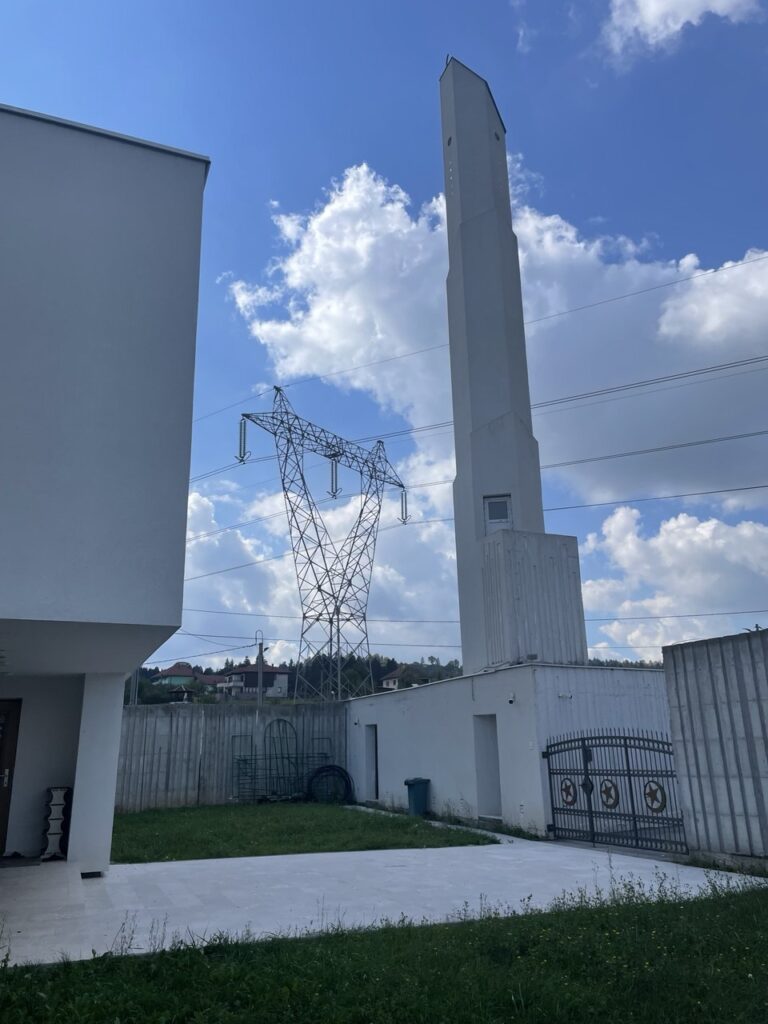
My surprise doesn’t stop there: the minaret towers over the edge of the agricultural plots, but the hexagonal spiral still loses the height competition against an enormous high-voltage trellis. “I can’t recollect that in the presentation” I grin, as I walk out of the cab.
We arrived, yet there is still something getting me anxious: I enthusiastically embarked in the fullness of my jury duties, but I underestimated the schedule of prayers. I only checked it once onboard: good, so we should arrive by 12:39, right. Let’s see when they pray…ok…today, Dhuhr [the 3rd pray] is at…fuck!
At 12:37.
During prayer no idiots please, I can expect that, especially if guilty of procedural nonchalance…
I don’t have much time.
How long does praying take?
The internet doesn’t want to take a position.
What do you mean, between 5 and 30 minutes?!? So much for outsourcing our intelligence to machines…
I propose the driver let the meter run, so that I won’t have to find another taxi in an area where it looks like they haven’t seen many before. I hope he understood. The gentle wind whistles through the nearby fields. I don’t hear anything, I get to think, but I doubt they pray screaming.
“Inside the perimeter, transition; under the porch, preparation; inside, introspection”. These were the words that the architects used to describe the atmospheres, something that inevitably makes me think of Ugljen.
Hesitant, I cross the gate into the first atmosphere: the wildflowers garden feels slightly squeezed into the small plot. Intelligently the architects decided to rotate 90 degrees the entrance to the mosque, to give a bit more breath to an otherwise rushed transition. As I turn the wall and face the door, I also notice that there are no shoes.
Years before I had noticed how, in Sarajevo, shoes are an architectural element: left outside, they are the only sign of the imperceptible presence of a mosque.
But not here. No shoes. That’s odd.
I put my hand on the doorknob, and I can’t describe the conflicting sense of relief when it doesn’t turn. Closed.
Finding it shut grants me a new sense of tranquility, and I notice the taxi driver peeking curious, he is still waiting; these two things make me move more freely.
I have only one way to experience the interior: lay my forehead on the wide glass curtains that wrap the three other sides. My arms try to block the sunlight, the reflection is blinding; I hold my breath to avoid condensation.
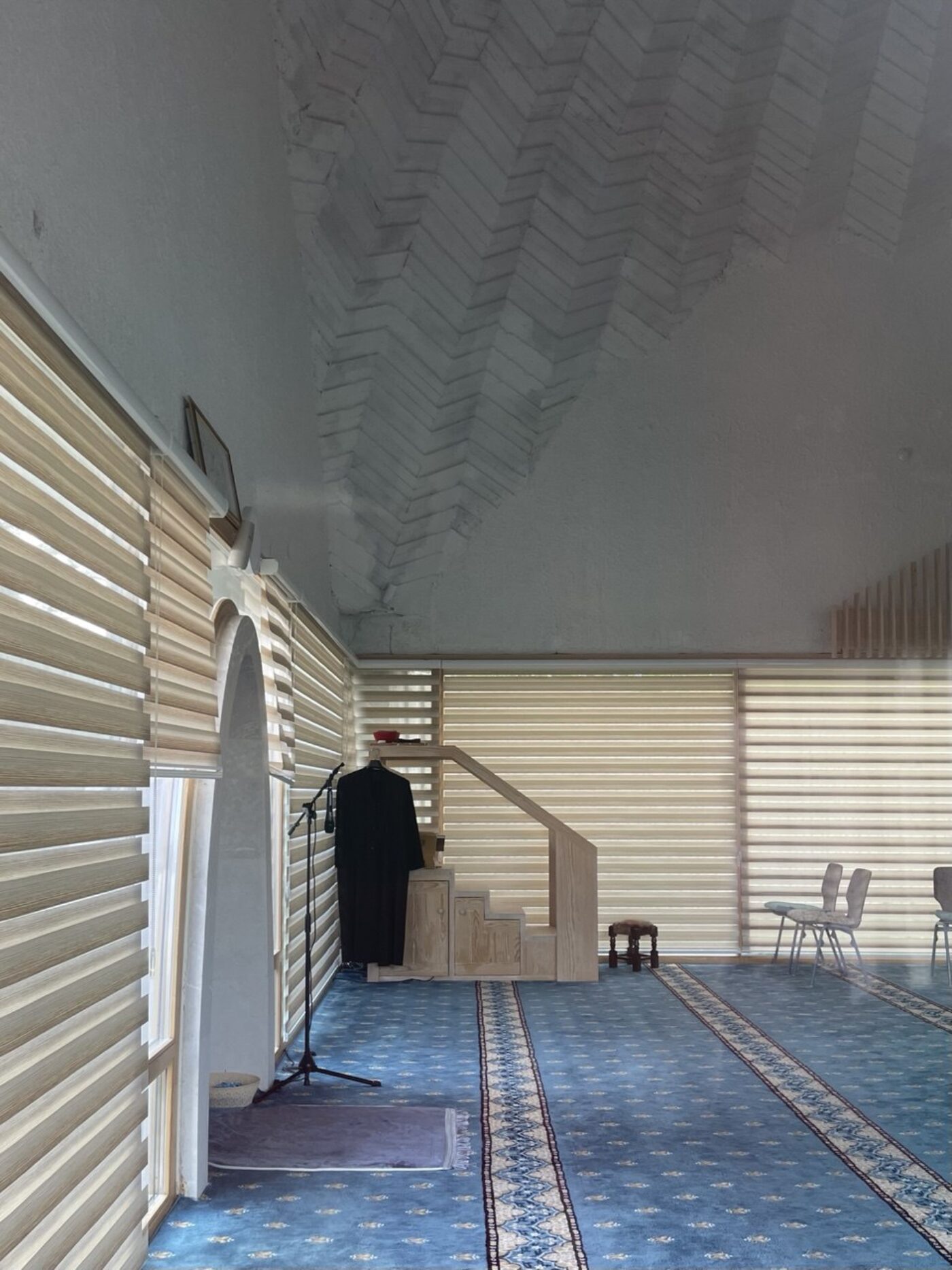
Despite knowing the project well on paper, the effect is still surprising: the visual continuity of the small green areas, broken rhythmically by the wooden mullions, makes visitors experience the mosque as a musalla instead [conventionally an outdoor space of prayer, often a small domed held by columns].
Above this glass strip, the white cube visible from the outside reveals its unexpected interior: a white, parabolic sail-vault, its herringbone brick framework subtly visible beneath the surface. From my unfavourable angle I only recognize the four corners where the sail anchors, yet I can already glimpse the evocative play of light awaiting believers inside.

Walking around the triangular patches of grass makes me appreciate the substance of perimetral wall, at first glance unnecessarily heavy. Its presence dialogs with the white cube above it, letting it gently lean on it. Overall, the project plays several compositional strings (volumetric compression-decompression, blurring inside and outside, a perimeter that becomes core structure) but the result is not staccato.
The squeak of a truck afar makes me snap out of contemplation; my time is running out fast. Outside the gate the taxi driver is smoking the third cigarette. Decades behind the steering-wheel, but I still read a vague disbelief: “what is there to see here?”
Sir, I disagree: if I did not come here, had I not visited Ugljen’s mosque too, the suble typological experiments might have perhaps gone unnoticed to a non-muslim. Instead they make me want to grab a pencil and design again – it’s been years that I did not feel this urge.
As the cab engine roars to scare the potholes away, I cannot help but reflect on the odd location: from this strange peri-urban plot my mind wanders, thinking how much the Balkans have become a geopolitical chessboard for powers like Turkey, Saudi Arabia, China. One pays for infrastructure, one for renovations around mosques or for the mosque itself – and Europe can’t articulate well its value proposition, while it sees its importance slipping away.
But before I start yet another digression, yes AHAKNAP, you can keep the award!
Related article