January 21, 2026
Building with what remains

At the end of 2025, VOLUME joined HouseEurope! and the OBEL Foundation in Brussels for a day of talks, site visits, and discussions focused on renovation, reuse, and the future of Europe’s building sector. The day progressed over construction sites and institutional settings, bringing together architects, contractors, developers, journalists, and policy makers in a shared itinerary.
The visit did not only frame renovation as an alternative or a corrective, but as a way of working with its own rhythms and organisational demands. Throughout the day, conversations returned to the infrastructures that make renovation possible: how responsibility is distributed between project teams, how second-hand materials reorganise planning and procurement, and how deconstruction reallocates labour when demolition is no longer treated as the only response to ageing buildings.
In this sense, Brussels did not appear as an abstract model, but as a place where these questions are already embedded in an ongoing practice. This condition of work in progress is important because it mirrors the scale and ambition of what HouseEurope! is trying to address with its current campaign.
HouseEurope! is a European Citizens’ Initiative advocating for a change in how Europe treats its existing building stock. The campaign starts from the observation that renovation and reuse are not marginal practices, but necessary ones, and that for them to become the norm rather than the exception, changes are needed at EU level. These changes extend beyond design culture to include legislation, taxation, financing, and assessment methods. With the construction sector responsible for a significant share of Europe’s carbon emissions and material waste, HouseEurope! positions existing buildings as one of Europe’s most important (and most overlooked) resources.

The campaign argues that renovation is already happening and that what is missing is a legal and economic framework capable of sustaining these practices at a larger scale. Seen through this lens, the Brussels visit functioned as a diagnostic, revealing how reuse depends on systems that extend beyond design decisions: supply chains for scavenged materials, labour arrangements for deconstruction, processes that allow for adaptive design, and financial instruments that recognise long-term value.
Over the course of the day, demolition and deconstruction kept returning as practical points of reference, opening up conversations about the processes that make it possible to work with existing buildings. While demolition implies erasure, deconstruction allows structures, materials, histories, and relationships to remain in use. This act of preservation keeps construction elements in circulation and brings into view forms of work that are often marginal to architectural narratives. Care, here, was not presented as a principle to be adopted, but became implicit as something embedded in how renovation projects are planned, sequenced, and maintained.
The conversations that followed helped clarify why reuse and renovation have not yet become standard spatial practices. Even though there is general recognition of the housing crisis and the environmental impact of the construction sector, existing legislation and financial models still tend to favour demolition and new construction. Renovation is often described as complex or risky, while replacement is perceived as easier to regulate, insure, and finance, and, perhaps, still carries an appeal rooted in the promise of the new.

At a European level, the environmental costs of demolition, such as the loss of embodied carbon and the generation of waste, remain only partially accounted for. Social costs, including displacement and everyday disruptions caused by demolition and construction work, are even less visible within formal assessment frameworks. As a result, projects that prioritise reuse often depend on exceptional working conditions between clients, authorities, and spatial practitioners, rather than on structural support. This is the imbalance HouseEurope! seeks to address. The campaign calls for concrete changes to EU law: reduced VAT on renovation and reused materials, better assessment of existing buildings, introduction of life-cycle carbon evaluations, and public incentives that support renovation rather than the total replacement of buildings. Seen through the experiences of the Brussels visit, these demands appear neither abstract nor ideological.
What is at stake is not only the environmental performance of architecture, but also how work is organised and valued. Reuse moves investment away from raw materials and toward people, labour, skills, and local economies. In this sense, it aligns ecological concerns with social ones, suggesting a different distribution of value within the construction sector.
The HouseEurope! campaign is currently in the final days of its collection of signatures, seeking the one million signatures required to trigger a formal response from the European Commission. Reaching this threshold would not immediately change the legislation, but it would oblige EU institutions to engage with the issue at a policy level.
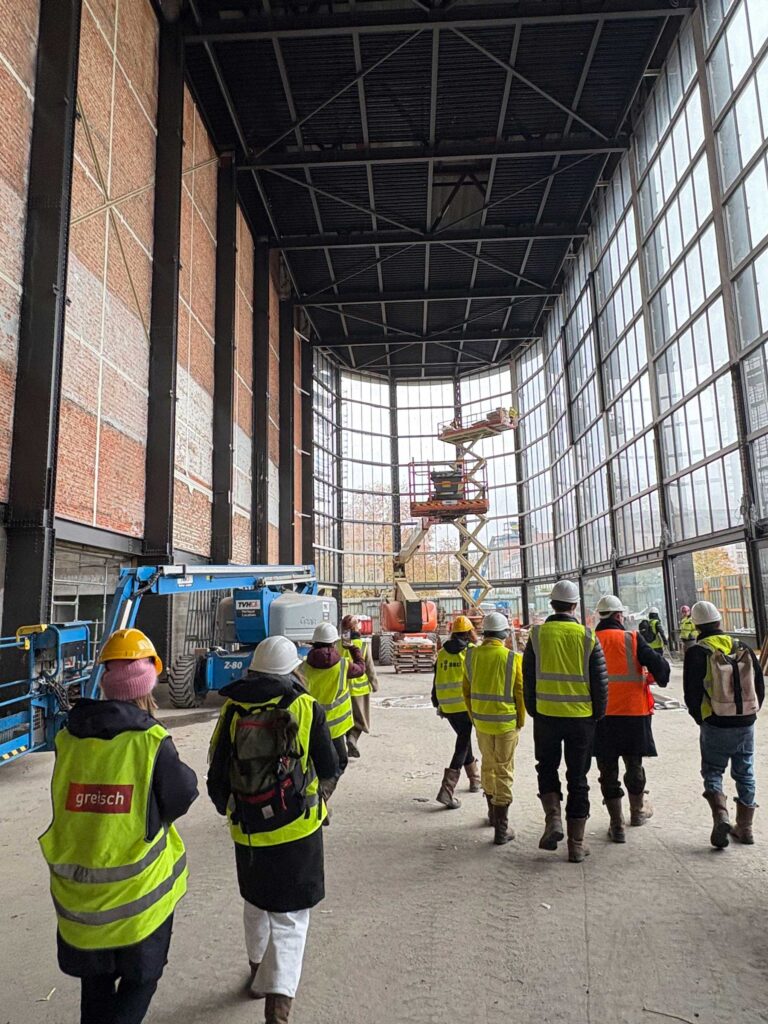
The Brussels visit did not present renovation as a finished model or a universal solution. What it offered instead was a glimpse of a trajectory already taking shape, one that treats existing buildings not as short-term assets, but as long-term commitments, and values labour, care, and patience. These practices exist. The question raised by HouseEurope!’s campaign is whether they will remain marginal or whether they will be supported at the scale they now require.
As the January 31st deadline approaches, only a few days remain to sign the petition. Sign, share, and share again!