December 13, 2025
Swiss Army Knife
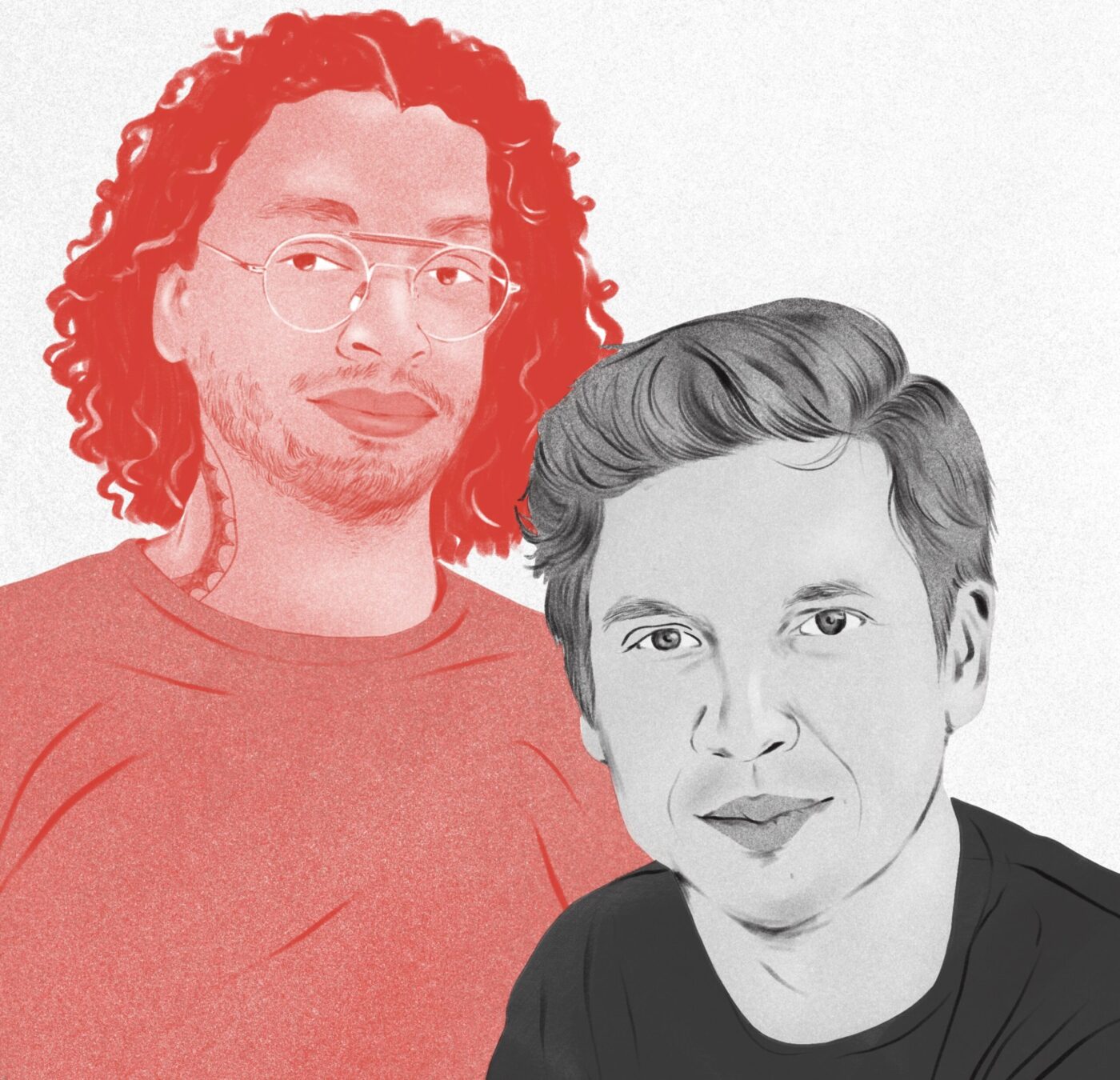
In this conversation between futurologist Ludwig Engel and chef David Zilber they discuss curiosity, storytelling, and the art of unlearning. Together, they explore how bursting disciplinary bubbles can lead to more expansive forms of collaboration, understanding, and transformation.
Ludwig Engel: For this specific piece in Volume, the topic is bursting bubbles. Therefore, my plan for the interview is that we just play around with this idea of bursting the bubble. I’ll introduce four strategies for doing that. I’d just pick your brain or see whatever comes to your mind first. You can answer biographically, professionally, or however you like.
David Zilber: OK, sounds good.
LE: So I thought that basically, a precondition for bursting a bubble is breaking out of your own bubble, right? This idea that you need to become conscious of your own systems thinking in order to break it – I mean, it happens intuitively, but there also needs to be a moment of reflection, a moment when you recognize that it actually happened. So you can make it reappear, or make it happen again. But that’s a very scholarly way to think of it… If I look at your biography, I’d think the last thing you ever thought about was bursting your own bubble. But in a way, the way you’ve done things – the curiosity you bring to everything you do – probably is exactly that.
In that sense, one might ask: How do you get out of your own mindset? How do you help other people get out of theirs? How do you escape your systemic contingencies? I think that’s pretty much what I try to do anyway, with everything I do in my work. And obviously, that’s also what you’re doing – maybe even in a much more hands-on way.
So maybe that’s my first question, tied to this strategy of breaking out of your own bubble. Would you identify one, two, maybe three biographical turning points or moments when, looking back, you felt, “Ok, this is where it happened?”
DZ: Yeah, I have one story that immediately comes to mind: When I first started cooking in high school, I was getting terrible grades. I was an apathetic student. The structure of high school just didn’t jive with me, which proves there’s more than one kind of smart in the world. I needed something hands-on, so I fell into restaurants. My first kitchen job came through a high school co-op program. They hired me afterwards, and I never went for higher education after that. I worked for that restaurant group for about two and a half years, split between two places – one fine dining Asian, the other was Italian. Very Fancy.
It was my first job, and it really was trial by fire. My parents didn’t want me to work part-time, thinking it would distract me from school – but that didn’t pan out. So this was my real education: 14-hour days, standing on my feet, learning what it meant to work. I had great chefs who nurtured me, saw potential, and taught me a lot. One thing that stayed with me was after I gave notice to move to Vancouver, the owner, Guy Rubino1– who’d worked at Nobu in New York – said, “You’ve done a fantastic job. You came in as a teenager, now you’re a young man. First, we press someone into the mold, then the creativity starts pouring out.” That line stuck with me.
Fast forward 20 years, now I’m co-hosting the inaugural Stanford Fermentation & Human Health Symposium with PhD researchers. It’s academia at the highest-level intersecting with food. Since I’ll be in San Francisco, I thought bucket-list restaurant, so I’m booking The French Laundry.
A funny thing, Netflix recently released Chef’s Table: Legends, and Thomas Keller2 – the chef of The French Laundry – was featured. I’ve worked with people who trained under him at almost every restaurant I’ve worked at. At my first job, the pastry chef was a disciple of Keller and taught me a lot. In one clip of the series, Keller says, “In the first part of your career, you make a name for yourself through your technique and creativity. And then you start giving back.” That really resonated.
I think about it a lot: at first, it’s about being broken into the mold, entering the bubble. Then, once you’re inside the bubble and aware of it, you feed off it. And even if you start expanding the bubble, you’re still inside it, but at some point there’s a flip of a switch and it stops being about accolades or proving yourself – the bubble bursts, and you start giving back.
A friend once said about a great chef, “He’s forgotten more shit than you’ve ever learned.” That idea – your brain being so full that whatever comes out of you just comes naturally – is powerful. Whether someone asks you a question or you’re speaking at a symposium, it just flows and the switch flips, the bubble bursts, and what was once inside you starts pouring out.
I get DMs every week where people are saying, “Thank you for teaching me,” or “I watched your MasterClass and it inspired me,” or “I started cooking or fermenting because of you.” That’s when you realize the bubble has popped and you’re touching people’s lives. Like Rubino said, you’re pressed into the mold then the creativity comes. Eventually, the dimensionality flips – it goes from something contained to something open.
That’s the powerful visual for me. You take everything you’ve learned over 20 years. All of this stuff has been chopped up and remixed in your brain and you don’t even know how you know what you know. But when you reach that point, you just start giving back. And then someone else picks up the baton and runs with it. You don’t control what they do with it, and that’s fine. That’s one of the most powerful images of a career arc, and how I think about bursting a bubble.
LE: That really resonates with me, especially when we talk about transdisciplinarity. It’s usually the people who are deeply rooted in their own field who truly contribute to transdisciplinary work. Not the ones who dabble in everything, but those who’ve committed to something long-term. Then there’s a real bubble to burst, something that can actually disseminate.
I feel that in my own work. I’ve spent 20 years focused on the concept of the future – I’ve let myself become “the future guy,” and that was fine. I could still see the bubble evolving. Now, I see how my work can move into other contexts. What I say doesn’t always need to make perfect sense to me anymore, it can be picked up and reshaped by others.
That’s why teaching has become so fulfilling. I’m no longer anxious about people taking ideas or opportunities from me. Like you said, I’ve reached a place of letting go – I am Zen in that regard.
Which leads into my next question: How do you help burst other people’s bubbles? You’re going to Stanford, you let people into your world, and that shifts theirs. You’re thanked for that. But what’s the best way to share knowledge?
Looking at your career, how do you get people to question their ways of doing things? Not by telling them what to do, but helping them believe in what they do? It’s almost a parental question. We want the next generation to be independent and self-aware. So, how do you guide without prescribing? What’s your experience?
DZ: Within my own silo, this is something I’ve known for a long time… In the introduction to The Noma3 Guide to Fermentation4, there’s a quote I love: “We hope this book can be a launching pad for home cooks and restaurants alike. When we think of our ideal readers, we talk equally about the parent who’s passionate about cooking for his or her family and doesn’t mind a weekend project as well, the professional cook or sous chef who can read between the lines and pull out novel ideas.” That’s the idea – we wrote the book to give knowledge away. Not just to share our techniques, but to help readers read between the lines. Understand how we messed up 15 times and how we stumbled onto a solution. We wanted to fast-track people to that point but also show them the thought process of how we got there.
The book ended up being wildly successful – almost too successful. It became a bit of a meme in gastronomy and fermentation circles. There’s a clip from Whiplash where J.K. Simmons is yelling to his class about a book. In the meme, there is someone waving our book around like, “Who brought this in here?” – as if every junior cook is messing with fermentation now5. But that’s the point. We distilled not just my 6.5 years at Noma, but 10-15 years of the restaurant’s fermentation work, trying to transmit that to readers in a way that focused on the gears, the mechanisms, and making them think about the cogs that make everything turn.
And it worked. There are Reddit threads where people are adapting our recipes, making Koji6 with grains we’ve never used, and creating new processes. There’s been this incredible bubbling up of creativity that almost acts like a citizen science that has come out on the flip side.
The same thing happened when I spoke at BMW. I was talking to car designers about how I stumbled on the recipe for a great tempeh burger and then it’s this whole transdisciplinary thing when you’re communicating with the designers of a car company and being like, yeah, I really had to look outside of my field to understand what parts of biology or science would work really well to solve this really specific problem. Recently, through my employer, Novonesis7, I gave a talk to 60 STEM undergrads at a career event. I just talked about what I know and about what I notice in my research: what cues feel promising and how those things can become new products or solutions.
When I speak to people outside my field – engineers, designers, artists – it’s not about connecting the dots for them. It’s about drawing the connect-the-dots page and letting them complete it. They will use their own constellation to draw the lines. They’ll have their own way of seeing those connections. One person might think analytically, another in colors or forms, but either way, they follow the trail in their own way.
I’ve always said fermentation is a great porthole into understanding nature at large. It seems obscure and mysterious, but the barrier to entry is actually quite simple. In five minutes, I can explain what fermentation is, where you encounter it, and how to try it yourself. That simplicity makes it easy to communicate across disciplines. Once people understand the basics, they get how deep the rabbit hole goes and how it might apply to their own work.
LE: Yeah! I mean, this is totally random, but I stumbled upon this pseudo-chef podcaster who analyzed a scene from The Bear8 where they try to do a fermentation from your book. He explains what they did wrong, and I thought it was hilarious.
There were so many layers, it felt like a visual fermentation process itself. You had the guys in the show who didn’t really know what they were doing, holding a book they didn’t quite understand, being commented on screen by someone who also wasn’t really part of it. So many loose ends, all reacting to each other.
But that’s kind of the beauty of it. It becomes a structure of feeling, almost a punk attitude. Whatever you bring in becomes part of the process. There’s immense power in curiosity and in feeling free – or maybe just welcomed enough – to try something. The beauty is that it’s not about telling someone, “This is what you need to know first.” It’s an invitation to a mindset, not a manual.
And I wonder, because I really have no idea about kitchens – why it always seems to me that a professional kitchen is kind of like a space station. Hierarchies exist but they aren’t necessarily about inequality but more about creating a sense of security. In intense moments, it’s not that people don’t want to be treated equally it’s just that there’s no time. Someone has to call the shots to keep everything running.
So my next bubble-bursting question, in that regard, would be: how do you break each other’s bubbles? Where are the moments when two areas (or more) of expertise come together and actually create something new? In this whole setup, where does that happen when do they come together to form a new bubble?
DZ: I would say that at Noma – and this came directly from René – there was a big push to do exactly that, even within the restaurant. First of all, there were Saturday night projects. From a creative standpoint, that was really important.
It is a hierarchy, and you’re absolutely right. For the restaurant to function, it’s less about protecting everyone – it probably creates a lot of violence and interpersonal dispute – but it ensures things run smoothly. If you’re a sous chef, you’re taking on things the chefs de partie below you shouldn’t have to worry about. Like staffing, if someone has to leave, or maintenance, or scheduling, they just need to know their bases and not have to worry about fixing others. Restaurants need to function like an assembly line.
Being in that structure – in a place like Noma – where, for example, as a chef de partie you’re plucking herbs or peeling vegetables, you realize that this is a massive ship with a lot of maintenance and moving parts. But there’s also this world-renowned center of creativity that feels extremely rarefied because it’s just like 3 or 4 sous chefs working with Renee, and then a few people working in a lab in this sort of ivory tower.
So, you’re doing an extremely hard job, it’s repetitive, and you need to be fully focused, dialed in every day, executing at the highest level. That’s demanding in itself. But then you start asking: how does all this come together? You only have this very cursory, surface-level understanding of the things that get passed down to you through the chain of command. Someone tells you: Here’s why we need to cure the horseradish in this fermented salt – because it has to taste this way. Do it every day. Don’t mess it up. Measure it by the gram. And you’re like: OK… but how does this actually work?
To René’s credit, he created a space for creativity. Cooks could present their own dishes once a week. You could ask the test kitchen if they had something new or go to the lab and try fermenting something in a new way. That was cool. Later, as the lab grew larger and the knowledge base got heavier, René started asking me to give short talks, he’d ask, “Can you explain garum9 or fish sauce in 15 minutes?” So I’d bring samples and explain them to the team. That started happening more and more.
At the same time, there was the MAD Symposium10 once a year, inviting the whole industry to Copenhagen to talk about science, fermentation, or structural issues in restaurants. That was another way of breaking bubbles.
When we moved into Noma 2.0, the work was so intense René said, “We need to give back to the interns.” He suggested inviting farmers or suppliers to come speak. I said that would be a logistical nightmare but offered to do short Q&A sessions during daily meetings. I did that for about a year, up until the pandemic. Someone once asked me, “Can you explain allergies? Because I don’t know what actually happens when someone has a shellfish allergy.” So I’d do intense research, watch videos, read papers, and explain it in simple terms. People really appreciated that.
You have to make time to intentionally burst bubbles. The best places I’ve worked – famous or not – have done that. When I worked at a butcher shop in Toronto, they organized field trips. We’d go to the elk farm or the chicken farm not just to visit, but to work with the farmers. It helped us understand the other side of what we did every day. And I think that’s incredibly fruitful.
You have to actively tear down silos or at least connect them to the ones that feed into yours, to stay engaged and curious.
LE: I’ve had the privilege of listening to you a couple of times already, and what always strikes me is that maybe you’ve been a teacher all along. Maybe your capacity to tell a story really is the secret of why you automatically come to mind when it comes to an interview like this, and just maybe, it’s not even your profession, but the way you can talk about it.
You just gave a very valuable insight: that you’ve basically been trained to give this information to your peers, right? But there’s something so powerful about how you weave all of the various aspects and experiences into a story.
So maybe that’s my last question, because as you said a lot of times, it’s not ultimately about the product that comes out of the process. You’re never concerned with that, you’re always concerned with the process, right?
You’re always like, this is the way you work, the way you celebrate, the way you have your party: the work is in the process. And maybe that could be the last story and a way to round this all off: how do you process these processes? How does that work? That it’s not repetitive, that it doesn’t come up with the same results again? That it really does change something? What is your story then?
DZ: When people say, “Oh, you’re good at telling stories, at teaching, at communicating,” or “you can de-jargon and explain complex topics pretty simply,” I realize that’s true. Actually, maybe I missed making this point in my very first answer, and I’m coming back to it now… the idea of becoming a teacher, of being pressed into the mold, with creativity then oozing out, and then inverting the bubble and giving back.
I love the idea that you don’t understand something yourself until you can explain it to a six-year-old. There have been so many times in my career or life where I’ve been asked a question about something I thought I knew and I’ve had to stop and ask myself, “Do I really know it well enough to make you understand it?” Even writing this book, which has now been translated into twelve or fifteen languages, and hit the New York Times bestseller list, was part of that.
There were so many moments where, in explaining something to someone else, I had my own aha moment, like, “Oh fuck, now I get it. Now I understand how this process works.” You have to go deep. You have to spend a lot of time with something, ferment everything you’ve learned — like a caterpillar melting itself down in the chrysalis and uses imaginal cells to rebuild itself from soup into something entirely new. That’s a bit how it is for a really good bubble-burster, someone who manages to step outside their domain and swim in the ocean with everybody else but fruitfully, making something useful out of it.
In my current setup, I feel really lucky that I don’t have a repetitive day-to-day. Maybe it’s because I’m a good storyteller, or I’m good on camera. Whatever it is, I’m the guy at Novonesis that a lot of different people will tap. I just got an email over the weekend from someone who’s basically the “you” of this company — someone who works on futures research and consumer insights in food. And he wants to tap me for a meeting. It could be something like designing a new space for our food production clients, like “How should we set up this meeting room/kitchen combo?” And they’ll say, “We know you’ve done this a lot, and probably made a lot of mistakes. How can we do this better?”
Or it might be an actual food product, and they’ll say, “Hey, can you reverse-engineer this mycelium-based steak that’s already on the market? Is this something we could make ourselves?” Or “Can we apply learnings from tempeh11 to soy milk?” Because the Chinese market is struggling with freshness and palatability issues in some of the beans. These are the kinds of questions I get, and they’re never the same — so I always have to burst my own bubble to figure out how to help people.
And yeah, like you said, maybe it connects in a roundabout way to the earlier conversation about working one job at Noma and staying in one lane. But now I actively have to pull together everything I’ve learned — whether it’s a deep life lesson like, “It’s good to call your friends and check in, so that one day when you need a favor, it doesn’t feel transactional,” or something extremely nerdy like the pH limits of a specific fungus.
You take all of that – life stuff, deep technical knowledge – throw it into a blender, and out comes this connect-the-dots constellation picture, like a kid’s workbook of your own life. And then you use that picture to solve a new problem. That’s how I process my own processes.
I said this during the painful editing phase of the book: I was tapped to write it because René and my boss at the Noma lab thought I was good with words. This was back in 2016 and my boss said, “David has a great writing voice.” And I told the publisher, “I get that. I was asked to write this book because I read a lot.” And I do – I read a lot, a lot.
Right now I’m writing another book, so the stack next to me isn’t very buried: Cheese and Culture, The Human Microbiome, Michael Pollan’s Cooked. That gives you an idea of the chapter I’m working on. But generally, when I’m not writing for a specific project, I’ll just pick up whatever grabs me: a book about black holes, or Daniel Kahneman’s writing on how the mind works, or a book on the geology of the Earth and its consequences.
You don’t know where the connections will come from until you’ve absorbed something, forgotten it, let it ferment and then, when you’re presented with a novel problem, suddenly there’s a dot on your map and you think, “Where does this go?” And you follow the line to a novel solution. That’s how I process things.
You kind of become an informational Swiss Army knife. But you’re also right, it helps to have gone deep in one topic. There are certain lessons you only learn from that kind of commitment, and you don’t get them by just being a jack-of-all-trades. So maybe that runs counter to the Swiss Army Knife metaphor – but maybe not.
Sources
[1] Guy Rubino is a Canadian chef and restaurateur, known for his avant-garde Toronto restaurant Rain and for co-hosting the Food Network show Made to Order with his brother Michael.
[2] One of the most celebrated American chefs, head chef and owner of the three star restaurant The French Laundry in California.
[3] A Copenhagen-based restaurant founded by René Redzepi in 2003, world-renowned for its innovative approach to Nordic cuisine and for pioneering the “New Nordic” movement. Frequently ranked among the best restaurants in the world, it became a hub for experimentation in fermentation and food science.
[4] The Noma Guide to Fermentation (2018) – Co-authored by David Zilber and René Redzepi, this influential cookbook and manual systematized years of Noma’s groundbreaking work on fermentation and made its techniques accessible to chefs and home cooks alike.
[5] Refers to Damien Chazelle’s 2014 film Whiplash. A scene of the abusive teacher yelling has been remixed online, here humorously re-captioned to suggest Zilber’s book had become unavoidable in kitchens.
[6] A Japanese fermentation starter made by inoculating grains (usually rice or barley) with the mold Aspergillus oryzae, essential in producing miso, soy sauce, and sake.
[7] A biosolutions company formed in 2024 through the merger of Novozymes and Chr. Hansen, where David Zilber currently works as a food scientist and fermentation specialist.
[8] Critically acclaimed American TV series (FX/Hulu, 2022– present) about a young fine-dining chef who returns home to run his family’s sandwich shop in Chicago. Known for its intense, realistic portrayal of kitchen culture and restaurant life.
[9] An ancient fermented fish sauce, source of umami flavours. Garum’s origins can be traced back to ancient Greece, Rome, Carthage and Byzantium.
[10] An annual event launched in 2011 by René Redzepi in Copenhagen that brings together chefs, scientists, artists, and activists to discuss the future of food and the restaurant industry.
[11] A traditional Indonesian food made from fermented soybeans bound together by the Rhizopus mold, producing a dense, high-protein cake.
Cover Illustration by Michelle Mildenberg Lara
VOLUME68: The Guide to Bursting Bubbles hosts 13 conversations in which architects and designers meet inspiring figures outside of their bubble to find points of engagement.
Related article