July 15, 2026
Floating in Lithium
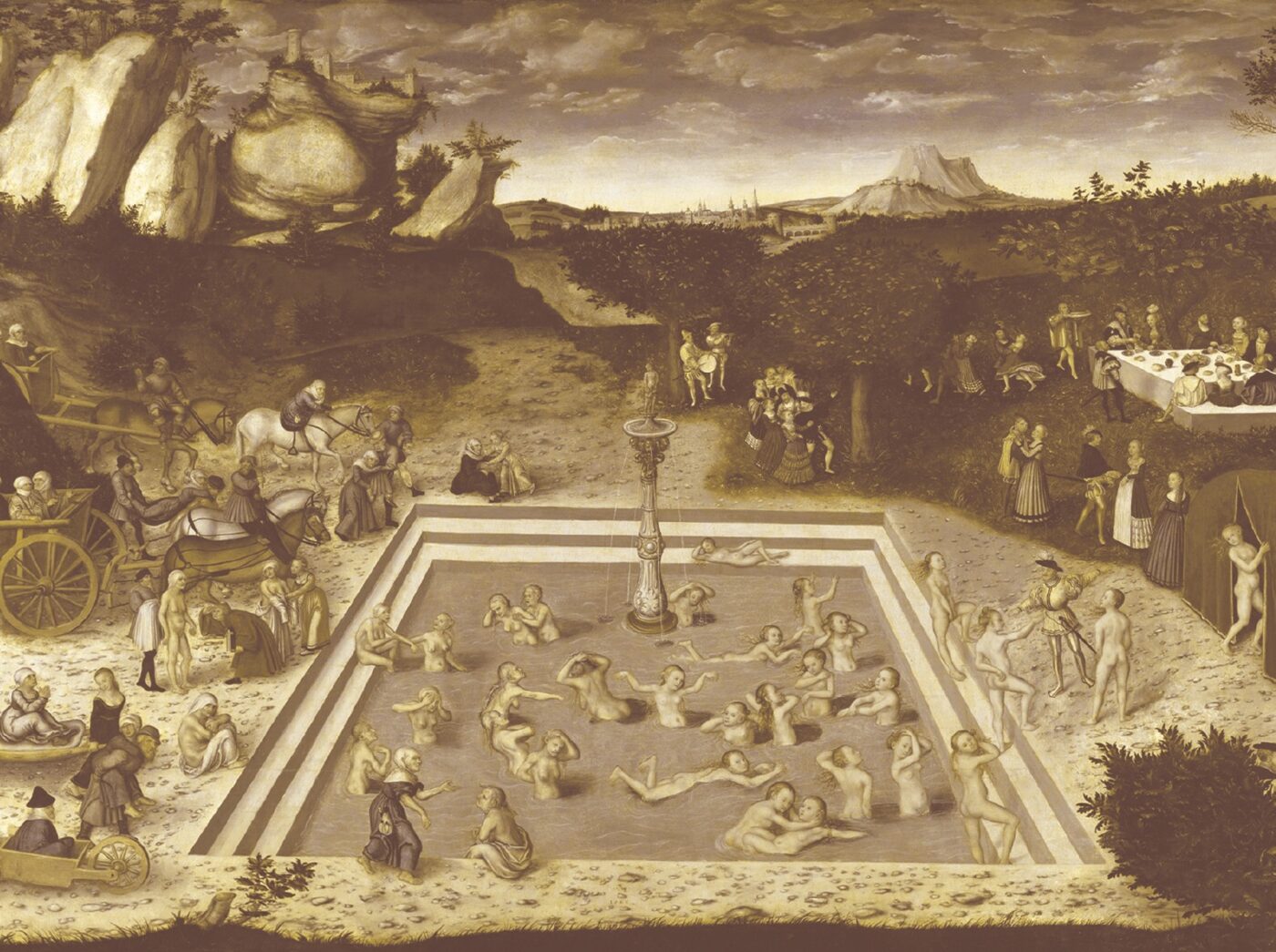
Groups of figures, often described as elderly and female, approach from the left. Many need assistance as they undress and enter a large pool; an architecture of promise and possibility. In these waters, their decrepitude falls away, discarded like clothes on the floor. Emerging on the right, youthful, their flesh reborn, they join a celebration of sensual pleasures.
Stories of a legendary spring have circulated for millennia. The myth of the quest for eternal youth is echoed in tales of waters that heal and rejuvenate anyone who dares to drink or bathe in them. Lucas Cranach the Elder’s The Fountain of Youth (1546) captures this yearning, the dance between ages. Yet, in depicting this systematic revitalization, he reveals the machinery beneath the myth – an emerging factory line producing bodies that are desirable and productive, all under the male gaze.
A window onto the past, onto the bathing culture of the Middle Ages, Cranach’s painting also anticipates the obsessions of contemporary media, where beauty myths are broadcast through before-and-after reels. Bodies in boudoirs, bathrooms, beauty parlors, and clinics in search of self-optimization, each transformation subjected to digital scrutiny. Images and videos chart the relentless pursuit of their physical prime, from makeup to skincare routines, from AI filters to aesthetic medicine and plastic surgery, mobilized to smooth, sharpen, raise, enhance faces and bodies. The bath and the screen – each one a mirror reflecting the deepest desires to “beautify” appearances and turn back the clock.
Bathing has long been associated with health, and, as Cranach’s painting shows, it wasn’t necessarily an individual, intimate act. Bathing meant bodies next to other bodies, immersed in collective architectures. Consider the Termas de Bande in Ourense, Spain. The Romans praised these hot springs for their therapeutic and recreational benefits. Between 69 and 79 CE, they built a mansion, a military camp, and an open-air thermal bath system where waters ranged from 36 to 48 degrees Celsius. The baths were abandoned by 120 CE and only rediscovered in the 1920s, when these remnants of forgotten pleasures resumed their ancient role. Not for long. In 1948 the site fell to the power-hungry infrastructure development of Francoist Spain. The Roman enclave was drowned beneath a hydroelectric reservoir that stretched for fourteen kilometers, displacing entire villages in its path.
Almost forty years later, in 1985, archaeologists unearthed the bathing infrastructure once more. Today, people can again gather here, undress and bathe together, floating in the mineral-rich warmth that flows from the depths of the mountain. Within these embodied experiences, one might comprehend the intricate thermal and material processes that connect human physiology to that of the planet. Bathing together, bodies engage in a practice of collective care, embracing forms of energy far removed from those embodied by the hydroelectric plant that sets the cold waters of the reservoir in motion.
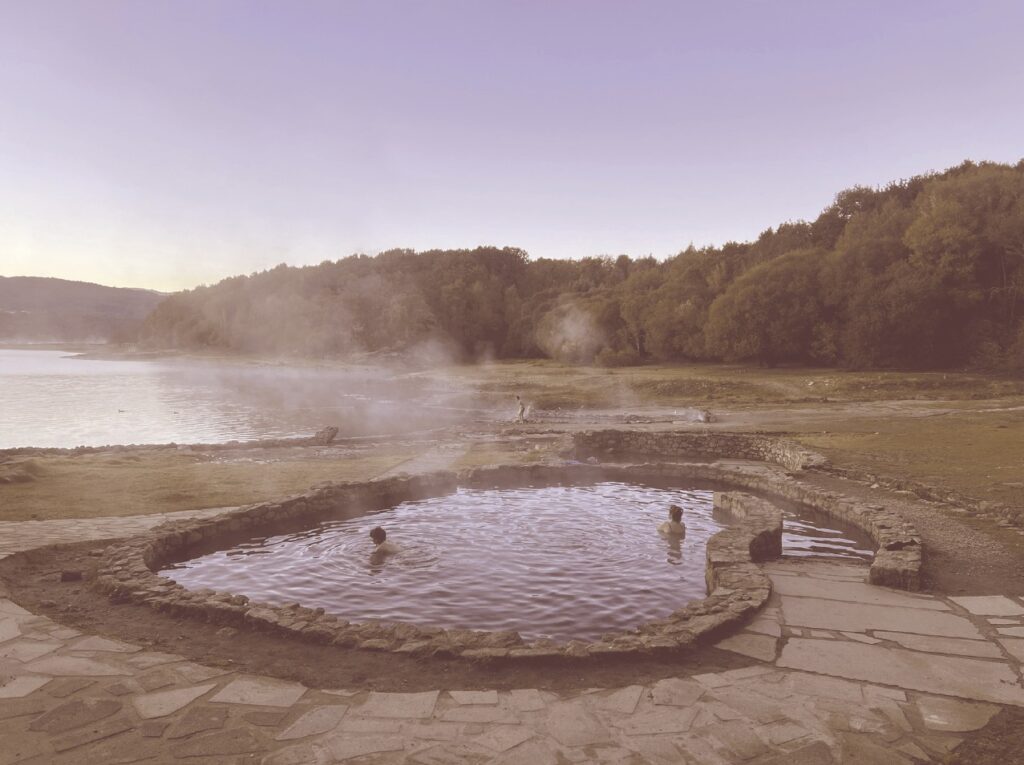
In Northern Portugal and Galicia’s thermal villages, in places like Bande, healing waters emanating from the entrails of mountains course through daily life. Locals have been drinking from these springs, filling bottles to carry home, and bathing in them for hundreds of years. Here, water is understood as more than just a resource to be consumed or stored; it is a catalyst for eco-social relationships. The ritual architectures surrounding these springs are charged with myths, blending the extraordinary with the everyday, inviting people to immerse themselves in or ingest them in search of vitality, well-being, and beauty.
Bande remains an exception, as a source of curative waters that has yet to fall under the spell of commercial exploitation. Elsewhere, hot springs have been formalized in fountains and spa architectures (like those in Mondariz, Guitiriz, or La Toja in Galicia, and Pedras Salgadas and Vidago in Northern Portugal) turning the region into a reference for European thermalism. A place where tourism, social life, and health converge.
During the era of rapid industrialization, these architectures offered bathing and drinking cures to an exhausted society. Public baths, along with holidays, popular leisure activities, and modern architecture, were a remedy for alleviating the fatigue of the nineteenth-century factory worker, preparing them for more labor.
Once seen as progressive means of social advancement, these healing “technologies” have now evolved into a billion-dollar industry. The presence of traditional spa towns continues to spur urban developments and resorts that draw tourists like modern-day fountains of youth. Enticing promises of rejuvenation keep the system running amid collective burnout, enabling a managerial technique based on a cycle of self-optimization, exploitation, and exhaustion of the neoliberal subject – a cycle that extends beyond human bodies to impact the entire environment.
Although in this cross-border region between Portugal and Galicia minerals emerge at the surface through thermal springs, they are also forcibly extracted from the ground. The healing waters that attract the wellness industry contain the same endogenous resources that mining corporations seek to extract, such as lithium. The Canadian company IberAmerican Lithium, which holds the rights to develop mines in Ourense, recently announced the discovery of a lithium “belt” stretching across the Luso-Galician mountains. Propelled by the so-called green transition, lithium mining threatens the region’s ecology and waters. It does so with the explicit backing of successive governments and the European Union, which frame these extraction projects as a solution to their national and continental energy requirements, given that lithium is used in the batteries powering smartphones, electric vehicles, data centers, and renewable energy systems.
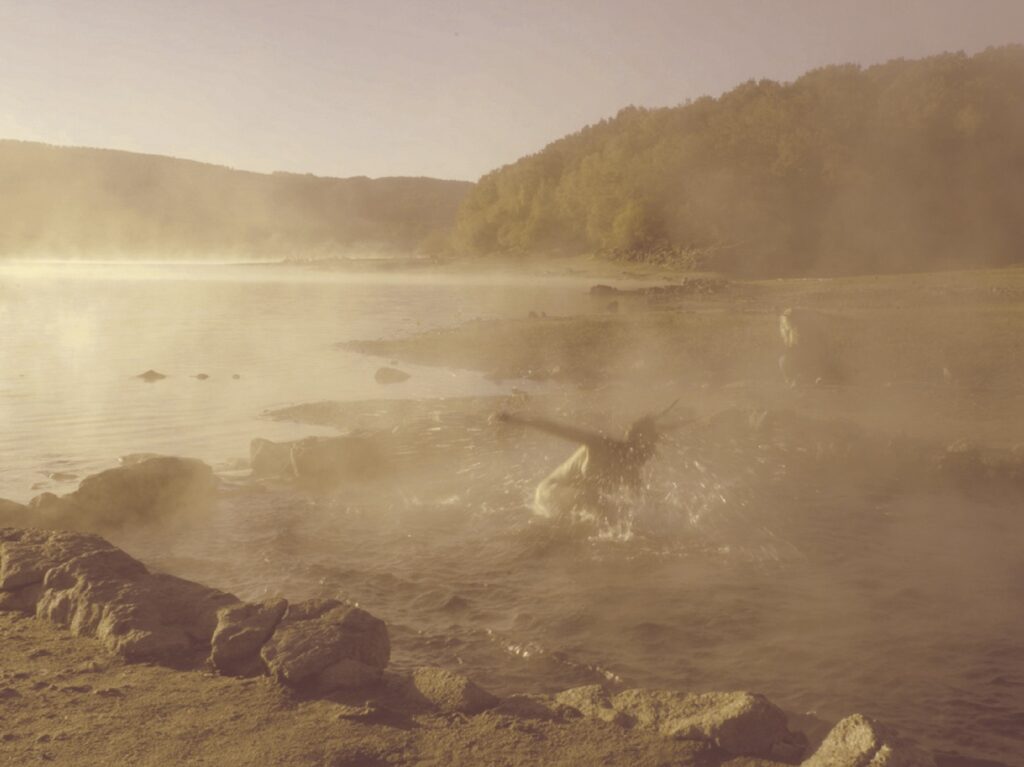
This convergence of mineral prospecting and thermal water sources highlights the critical role of lithium; in both high-profile energy projects and powering technological devices as well as preserving the well-being of those who at the heart of them. If, in the 19th and 20th centuries, lithium-rich waters were sought as remedies for ailments caused by rapid industrialization, sustained by the burning of fossil fuels that kept machines and their operators running, in the 21st century lithium is presented as the key to the transition toward a decarbonized economy. A transition, however, that lacks critical questioning surrounding its pace of production and consumption that pushes both the planet and its inhabitants to the limit.
The lithium-driven futures envisioned for this region of the northwestern Iberian Peninsula appear irreconcilable. On the one hand, mines promise to transform the territory into a center of extraction and processing. On the other, thermal architectures offer the possibility of consolidating the region as a site dedicated to ecological care and health. Their coexistence seems unlikely. Mining activities pose substantial risks to the water systems that sustain these thermal sources and their ecosystems. The issue becomes even more critical when projects are overlaid on the map: the planned lithium mines in northern Portugal and Galicia are located a little over 23 kilometers from important water springs and significant clusters of thermal baths. This proximity makes ecological impact inevitable.
Mining requires the removal of the upper layers of soil – and everything in its path – until reaching the bedrock. This process destroys the structures that sustain a complex network of life and severely affects activities such as grazing, agriculture, and forestry, which are pillars of the local economy and culture. The intrinsic relationship between the mountain and its inhabitants is largely due to the ecosocial structure of the baldíos and montes vecinales en man común (common lands), which form the material basis for the organization and management of resources in this region. Having survived since medieval times, these commons are now threatened by mining companies whose projects will profoundly alter the ecosystems of their ancestral landscapes – places that communities have cared for and loved for generations.
Excavating the mountain would also impact the hydrological networks that give life to this region. Lithium mining requires enormous quantities of water – more than 500 million liters per year. To meet this demand, mining companies plan to interrupt the natural flow of several rivers and store their water by constructing dams next to the mine pits, altering natural drainage patterns and lowering groundwater levels in some areas, including nearby springs and thermal sources. Competition for water is not the only issue. The chemicals used in lithium processing, such as acids and reagents, together with tailings, can seep into aquifers and nearby watercourses. The impact would be considerable, particularly for communities near extraction sites, who face the trauma of seeing the mountains and their structures of coexistence destroyed, putting at risk all living beings that are dependent on them.
This is why local populations contest these mining projects through a series of sustained protests that have lasted for more than five years. Amid the exhaustion of continuous struggle against pressure from corporations and governments, they find solace when they surrender to the sensual gifts of the granitic mountain. Immersed in what poet and activist Cheila Rodrigues defines as a “bath assembly”; intergenerational, intersectional, and transborder communities come together to discuss alternatives to the extractivist model as they bathe together in the lithium-rich waters that flow through the territory. In doing so, they take part in a practice of resistance and collective care, embracing notions of energy far removed from those exemplified by the mine looming over the region or the industries that would depend on the lithium extracted from it. They also show that, despite the ongoing instrumentalization of the mountain and its bodies of water for energy projects – whether for bodily or planetary demands, premium balnearies, or mines – bathing architectures can still serve as a counterpoint, nurturing conviviality.
Composting
When people immerse themselves in public baths, their skin, hair, and fluids mingle, releasing microbes that float in the water. In this “wet-togetherness”, bodies coexist and intertwine, and the boundaries between them blur. Against the notion of skin as armor and bathing as a private, mechanized activity, this encounter reveals a porous and collective architecture. One of humidity, viscosity, and softness, which also manifests in acts such as breathing, menstruating, ejaculating, and decomposing.
Understood in this way, the architectures of bathing can act as a counterpoint to the atomization of neoliberal society, to binary constructions, to anthropocentrism. Yet, in most cases, baths strive to maintain the illusion that bodies are discrete, and leaks avoidable. Valves and barriers organize the circulation and containment of fluids to prevent unwanted exchanges. Hoses, pipes, sewers, shut-off valves, and ducts hidden behind walls, in basements, or under ceilings determine which liquids enter our world(s) and which leave, introducing or extracting elements in order to keep them concealed. As Mark Wigley reminds us, architecture becomes a technique for managing human psychosexual shame.
Despite these efforts, leaks persist. Existence in this world is inseparable from the production of secretions. Architecture’s attempts to control fluid matter through disciplinary boundaries ultimately confront the overflow of what has been repressed. To obsess over maintaining the illusion of absolute impermeability is to forget that we need to appreciate this decomposing collectivity that is the world: a feast for celebrating life.
This is how the commons that characterize the region of North Portugal and Galicia are formed: communal lands resulting from a continuous process of composting organic and mineral remains that, over time, become embedded into the soil. These commons are living spaces, woven through centuries of interaction among humans, animals, plants, and microorganisms, where the cycle of life and death constructs fertile landscapes that sustain and generate these communities. The same occurs with their waters, which originate in the mountains. There, in the rocky depths, they are enriched with minerals that, carried by springs and rivers, become part of the metabolism of the environment and of its human and nonhuman inhabitants. It is a process of constant digestion and transformation in which the mountains sustain life and become part of those who inhabit them.
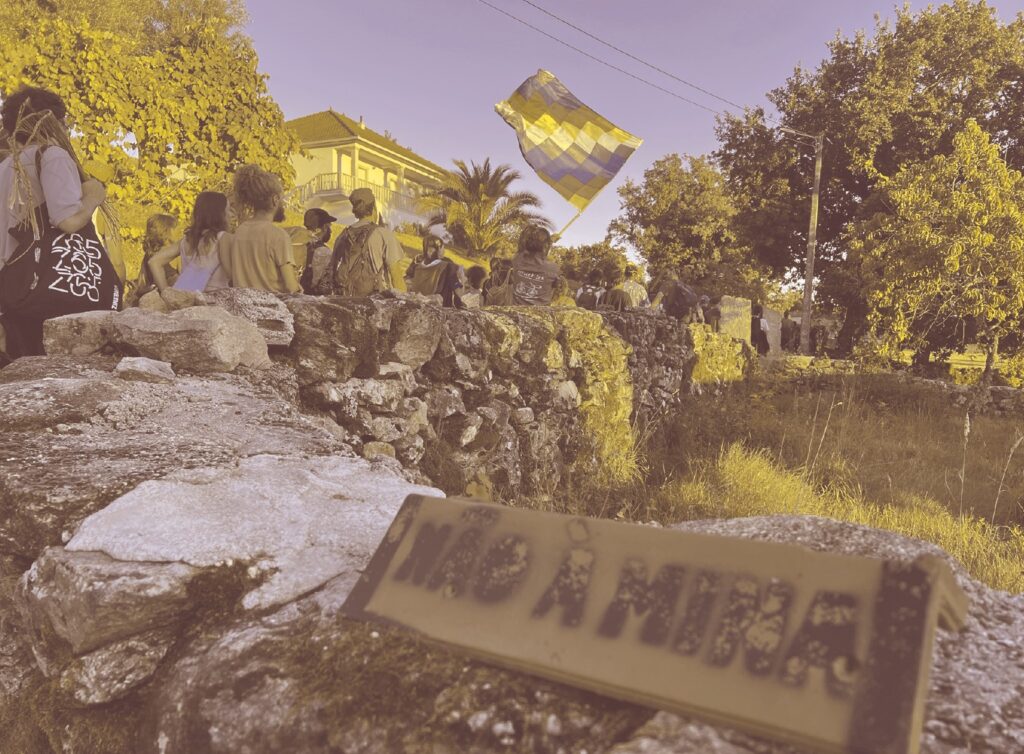
When this balance is disrupted by large-scale extractive processes, the slow cycles of regeneration are interrupted. Ecological fabrics are fragmented, and beings are detached from the rhythms that have historically sustained them. Energy, health, and beauty then become industrial products for consumption. Yet, none of these is an individual or exclusively human possession. They are constitutive elements of a collective desire that traverses past, present, and future existences. A desire that does not orient itself toward capitalist consumption but, as the biologist Andreas Weber describes, manifests as an erotic impulse essential to life, urging beings to relate deeply to the earth and to those who inhabit it. It is a fluid longing, a force that drives entanglement and mutual becoming, challenging the tendency to instrumentalize and subjugate the other that has foreclosed possible futures for humans and nonhumans alike.
Let us leave the common lands of the Iberian Peninsula and return, for a moment, to the fountain of youth with which we began this essay. Let us now try to imagine that pool of soaking bodies in transformation from a renewed perspective. One in which the fountain of youth – and all those inspired by it – abandons its industrial disguise and ceases to serve the logic of optimization. If I half close my eyes, I glimpse an architecture of composting where coexistence among diverse beings is practiced, both in their generation and in their decomposition. Contingent relations, woven around fluid matter, reveal a collectivity beyond human limits, giving rise to bonds of solidarity, embodiment, and desire. I see a humid architecture, where mountains and the creatures that compose them meet in a generous embrace, sharing their energy and their becoming.
Note: This essay is an abridged version of my latest book, Flotando en Litio (Madrid: Caniche, 2025).
Sources
[1] Aquis Querquennis: http://www.aquisquerquennis.es/en/the-roman-fort/.
[2]Embalse de As Conchas, Ministerio de Agricultura, Pesca y Alimentación, Gobierno de España.
See Xoán Carmona Badía, La Sociedad General Gallega de Electricidad y la formación del sistema eléctrico gallego 1900–1955 (Barcelona: Fundación Gas Natural Fendosa, 2016).
[3] I refer here to philosopher Michael Marder’s work on the relationship between philosophy and energy. Marder draws from physics, particularly the concept of electricity, to explore the implications of current practices of extracting, procuring, and consuming energy. He argues that current conceptions of energy prioritize potentiality over actuality and justify the destruction of bodies and ecosystems in the pursuit of energy. See Michael Marder, Energy Dreams: Of Actuality. (New York: Columbia University Press, 2017).
[4] I have previously published on these architectures in the book Flotandoe n Lition (Caniche, 2025) and the essay “Estar com as montamhas rebeldes,” Lítio: Estados de Exaustão, ed. Francisco Diaz, Anastasia Kubrak, Marina Otero Verzier (Porto: Dafne Editora, 2023). This research was also presented in the exhibition Wet Dreams at CentroCentro, Madrid, 2024.
[5] See Anson Rabinbach. The Human Motor: Energy, Fatigue, and the Origins of Modernity (Berkeley: University of California Press, 1992), 48. Rabinbach’s seminal book reflects on how the body was rendered as a “thermodynamic machine capable of conserving and deploying energy.”
[6] See Sigfried Giedion, “The Mechanization of the Bath,” Mechanization Takes Command (New York: Oxford University Press, 1948), 628.
[7] These arguments have been further developed in the book Flotando en Litio (2025) and in Lithium: States of Exhaustion, ed. Francisco Díaz, Anastasia Kubrak, Marina Otero (Rotterdam / Santiago: Het Nieuwe Instituut / Ediciones ARQ, 2021). In particular see Christie Pearson, “The Architecture of the European Mineral Spa,” 20–23.
[8] Silva, Bárbara (2024, December 23). «IberAmerican alerta para “colisão” entre minas de lítio na Galiza e norte de Portugal», in Jornal de Negócios.
[9] Ampliação da Mina do Barroso, Estudo de Impacte Ambiental, Resumo Não Técnico. p. 80.
[10] I am referring primarily to the sustained protests in Covas de Barroso led by the association Unidos em Defesa de Covas do Barroso, for whom I have great respect, with whom I have collaborated for several years, and to whose struggle I have dedicated my work on lithium extraction.
[11] “Wet-Togetherness” is a key concept of the 13th Shanghai Biennale, Bodies of Water, which was chief-curated by Andrés Jaque with a curatorial team composed of Marina Otero Verzier, Lucia Pietroiusti, Filipa Ramos, and YOU Mi, and organized and promoted by the Power Station of Art.
[12] “Your Restroom is a Battleground” (2021) by Matilde Cassani, Ignacio G. Galán, Iván L. Munuera, and Joel Sanders challenges this conventional view by positioning restrooms as contested spaces that shape how bodies and communities come together, where religion, race, ability, hygiene, health, environmental concerns, and economics play a fundamental role.
[13] Check valves block fluid flow in one direction while allowing it in the other, preventing unpleasant odors and situations. Andrés Jaque’s work positions these devices as an architecture that challenges dominant structures of contemporary cities and, in particular, real estate pressure. See Andrés Jaque Mies y la gata niebla: Ensayos sobre arquitectura y cosmopolítica (Barcelona: Puente Editores, 2019)/
[14] Mark Wigley has written extensively about architecture’s nervous encounter with liquids and the architecture of pipes. See for instance “The Excremental Interior,” Digestion series, eflux architecture, September 2022. See also “Pipeless Dreams,” in Mark Wigley, Buckminster Fuller Inc.: Architecture in the Age of the Radio (Zurich: Lars Müller, 2015).
[15] See Andreas Weber, Matter and Desire: An Erotic Ecology, trans. Rory Bradley (River Junction: Chelsea Green Publishing, 2014).
Related article